
Monitoring activity in airspace around airports is becoming increasingly complex. The rising concern regarding unidentified drones makes it vitally important that our understanding of what is happening in the airspace is accurate. Such accuracy depends on interpreting continuous streams of data from heterogeneous sources – lots of data. Radar observations, aircraft position reports, UAV telemetry, flight plans and airspace restrictions may all contribute to a continuously changing operational picture. Data must be collected from distributed sources, combined, analysed, and delivered to the people and systems responsible for making decisions.
Consider a radar reporting airspace observations that could reveal the appearance of an unregistered or uncooperative drone in airport airspace. This stream of observations must travel across a network to inform services that can correlate them with other surveillance sources of information so that we can maintain a continuous assessment of airspace integrity.
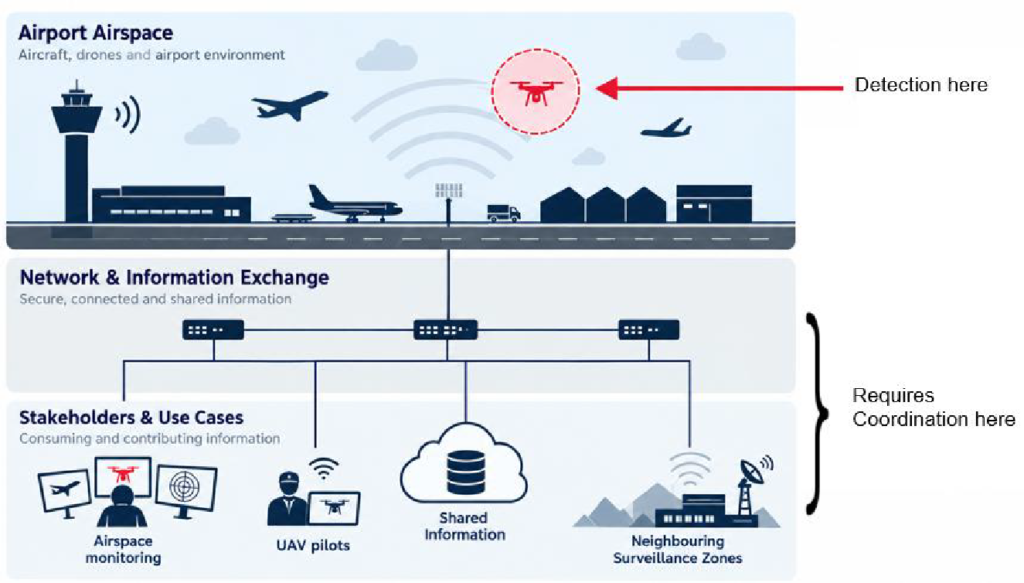
A router in the network path may be forwarding packets correctly while being incorrectly configured, compromised or intermittently faulty. From the perspective of conventional traffic engineering, the router may well appear healthy and delivering service in line with performance expectations. However, data could be selectively dropped, delayed or redirected while the network continues to appear operational and, in the case of a router compromise by a malicious actor, this debilitating disruption could be targeted at critical data streams at critical times with the aim of introducing brief fractures in the operational airspace view. Conventional network traffic engineering is focused on satisfying performance-driven service-level targets, and, from an application perspective, we can observe whether a network path is satisfying performance needs through metrics such as end-to-end latency, throughput and jitter. Such metrics can be continuously measured and assessed at the application level, and this enables applications to react dynamically with tactics such as buffering to compensate for excessive jitter or reducing data fidelity to compensate for low bandwidth.
CASTOR Horizon augments traffic engineering with a new dimension – trust. Through continuous monitoring and assessment of the routing infrastructure, CASTOR elevates trust to a first-class routing consideration, enabling dynamic routing and rerouting according to a changing trust landscape and application requirements. Unlike performance characteristics such as latency and throughput, however, the trustworthiness of the underlying network infrastructure cannot be established simply by observing the traffic arriving at an application. CASTOR aims not just to continuously assess trustworthiness and react to it but to inform user applications when they are operating over a path with sufficient trustworthiness to satisfy their needs. Just as user applications can dynamically adjust their operations to suit the observed performance of their network path, now applications could adapt according to the dynamic trustworthiness of the network infrastructure through which they are communicating.
Keeping critical surveillance moving
Collins Aerospace is contributing to and evaluating CASTOR in the context of critical aerospace communications. In tandem with contributing to core technical work in trust assessment, Collins team is exploring two scenarios involving the exchange of airspace surveillance information, each examining a different aspect of the relationship between network trustworthiness and the applications that depend on it.
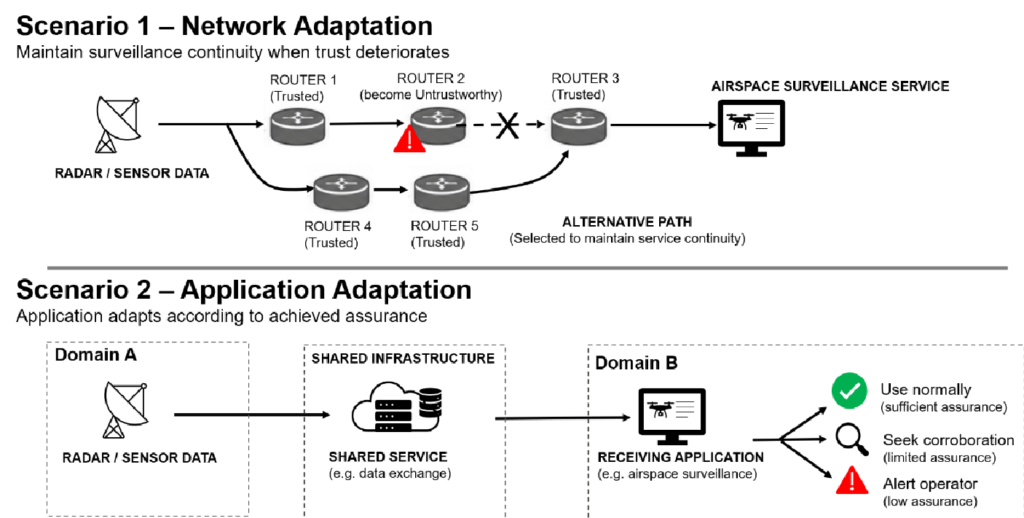
The first scenario considers the network infrastructure supporting surveillance operations within an airport environment. Radar observations and other sensor data must be transported to services responsible for maintaining an accurate picture of activity in the surrounding airspace. The availability and integrity of these data streams are particularly important when attempting to detect and track unidentified or uncooperative aircraft.
The aim is to investigate what happens when the trustworthiness of a router carrying this traffic deteriorates, even though it may continue to forward packets and satisfy conventional network performance expectations. Can CASTOR detect and assess the change and use that assessment to influence traffic engineering? Can the network move critical surveillance traffic onto a more trustworthy path while maintaining continuity of the surveillance service? We are particularly interested in observing the impact of such adaptations on the delivery of surveillance data and whether disruption can be kept within acceptable operational limits.
The second scenario considers the sharing of surveillance information across organisational and network boundaries. Airspace surveillance is not always confined to a single airport or operational domain. An observation made in one surveillance area may be relevant to services operating elsewhere, with information exchanged through shared infrastructure.
In this case, the receiving application may know the original source of the information but have little visibility of the trustworthiness of the network infrastructure through which it travelled. CASTOR provides a means of sharing the level of service assurance achieved across the domains involved, without requiring the receiving application to have detailed knowledge of the underlying network infrastructure or its trustworthiness assessments.
We want to explore how an application might use this information. Depending on the level of assurance achieved, an application might continue to process received observations normally, seek corroboration from another surveillance source, or alert an operator that the information is being received over infrastructure that does not satisfy its requirements.
As digital infrastructures become more interconnected, trust is becoming an increasingly important part of the picture. By bringing trustworthiness into traffic engineering, CASTOR Horizon is exploring new ways to support more resilient, adaptive, and trustworthy communications, helping ensure that critical information can be relied upon when it matters most.