
CASTOR Horizon will be featured at the ICT 2026 Conference in Thessaloniki, a leading international event bringing together researchers, industry experts, and policymakers to discuss the future of information and communication technologies.
As part of the conference, FERON Technologies, partner in CASTOR, is organizing a Special Session on Mission Critical Services in 6G (SS6), focusing on key challenges and innovations shaping next-generation critical infrastructures. The session will explore topics such as security, privacy, and trust mechanisms, zero-trust architectures, dynamic trust management, and resilient communication systems.
CASTOR supports this special session and contributes to advancing discussions around trusted networking and secure service delivery in mission-critical environments. CASTOR partners are invited to submit contributions, and the broader community is also encouraged to participate.
📄 Call for papers is open until 1 April 2026
🔗 Submissions: https://www.edas.info/newPaper.php?c=34652
The ICT 2026 Conference is technically co-sponsored by the IEEE Communications Society, and accepted papers will be published in IEEE Xplore, subject to quality requirements.
———————–
Event update:
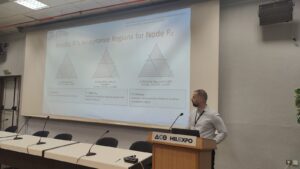
FERON presented the paper “Taming the Trust Hydra: Multi-Level Monte Carlo for Dynamic ‘Required Trust Level’ Management”, authored by Alexandros Fakis (University of the Aegean), Nikolaos Fotos and Sofia Anna Menesidou (UBITECH), Konstantinos Maliatsos (University of the Aegean and University of Piraeus), and Thanassis Giannetsos (UBITECH).
The work introduced a risk-based methodology for automatically deriving trust thresholds for 5G network routing, based on three dimensions of attack risk: node vulnerability, lateral movement probability, and attacker intent. These factors were combined through Monte Carlo simulations to generate per-node trust thresholds compatible with Subjective Logic. The evaluation showed that topology-aware thresholds were more stringent than static, single-node approaches, helping to avoid the systematic underestimation of risks associated with multi-hop attacks.